When BIM meets AI, it’s not hype—it’s higher returns!
Imagine this: Your engineering team is trying to efficiently route cables to minimize length using evolutionary models. Instead of coding constraints or fine-tuning parameters, they simply text their requirement — and the AI takes care of it, generating optimized routing paths, all while respecting safety and geometric constraints.
As simple as that!
BIM – Can you afford to find out a design doesn’t work—only after it’s built?
On an infrastructure master plan, your team is working on the hospital, someone else is assembling the airport, and another team is laying out the roads. Now imagine discovering that a road cuts straight through the hospital’s emergency room—or worse, the airport’s flight path overlaps with a high-rise building.
That’s exactly what can happen in construction when design elements clash—except it’s not just plastic bricks at stake, but time, money, and safety.
This is where BIM clash detection services come in—they’re a big part of BIM coordination services and act like the glue that keeps everything working together. And now, with AI in the mix, it’s all happening faster, smarter, and more smoothly than ever.
Understanding BIM Clash Detection
What is clash detection in BIM?
Clash detection, in simple terms, is the process of identifying conflicts or interferences within a 3D BIM model. A BIM tool like Navisworks spots conflicts between structural, architectural, mechanical, electrical, plumbing (MEP), or other systems before they turn into full-blown disasters on site.
There are three main types of clashes:
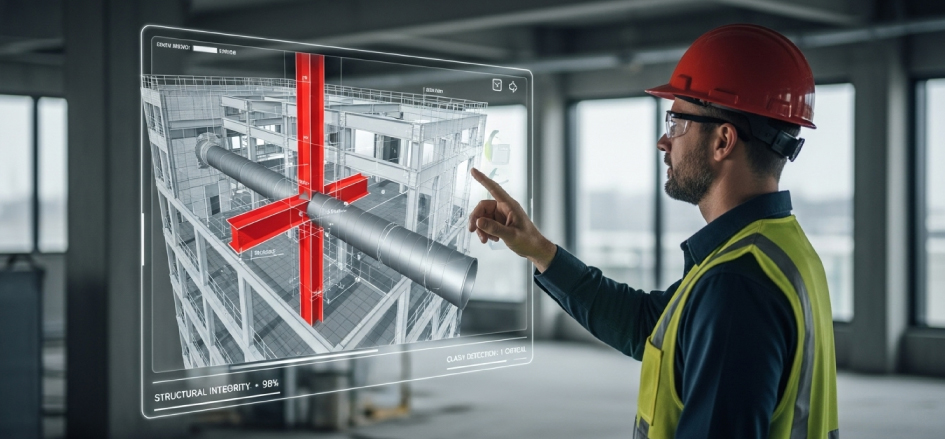
- Hard Clashes – A hard clash happens when two components occupy the same physical space. It means elements are literally colliding like a steel beam intersecting with an HVAC duct.
- Soft Clashes – It’s a clash even though components don’t really touch each other, like a pipe placed too close to an electrical cable tray without the required 150 mm safety clearance.
- Workflow-related Clashes – Scheduling or sequencing issues, like inviting the painters before the walls are built.
Traditional clash detection methods and their limitations:
Traditional BIM clash detection procedures (using evolutionary optimization models) rely on rule-based clash detection software like Navisworks. While effective, they:
- Require manual rule setting and review – like pipes must be 200mm away from beams before detection even begins.
- Often generate hundreds or thousands of false positives – like flagging every light fixture that’s 1mm too close to a wall, even when it’s not an actual problem.
- Depend heavily on human expertise to interpret results – an experienced coordinator still has to sift through all the clashes to decide which ones are real threats to construction.
This process, through BIM clash detection software, although accurate in expert hands, is time-consuming and prone to oversight—especially on large-scale projects involving multiple stakeholders and disciplines.
The Rise of AI in BIM Coordination
Enter artificial Intelligence —and boy — isn’t there a shift from tedious manual detection to smart, automated insights?
How AI Enhances Clash Detection?
Imagine this: You are planning and coordinating technical installations like ventilation and electrical systems. You spend hours drawing everything into place only to find out during a clash detection session in Solibri that half of it doesn’t work! Now, AI analyzes the building model and provides automatic suggestions for pipe routes, cable trays, and ventilation shafts, ensuring they don’t conflict with beams, walls, or other systems. This is what you call a real-time clash detection. Imagine right at the designing process, a system actively warns you if your pipes are too close to a wall or if your cables will run into HVAC ducts.
- Pattern Recognition: AI models don’t do the same mistake again – they learn from previous clash data to detect patterns across 3D BIM coordination models—reducing repetitive false clashes.
- Contextual Understanding: AI sees more than shapes—it understands context. A pipe cutting through drywall might be acceptable, but not through a load-bearing wall, right?
- Predictive Analytics: AI can forecast potential future clashes based on design intent – Think: “Hey, if you keep placing that HVAC duct like that, it’s going to clash your sprinkler system in three weeks.”
Benefits of AI-Powered Clash Detection
Adopting AI in BIM clash detection is like giving your model a sixth sense— for tangible benefits—it just knows where things will go wrong.
- Reduced Project Delays & Cost Overruns: AI pinpoints critical clashes early, preventing costly on-site modifications – you save on additional labor cost and time.
- Improved Collaboration Across Teams: AI tools automatically route clashes to the right teams, saving time spent on assignment time for meetings, scheduling, etc.
- Real-Time Detection & Resolution: Cloud-based platforms allow teams to perform BIM clash detection online— anywhere, anytime. In simple terms, you get real-time updates and clash resolution—no matter where your teams are.
- Enhanced Visualization & Reporting: Forget endless spreadsheets — AI serves up heatmaps and dashboards that actually make sense for stakeholders to prioritize issues and take faster action.
BIM Coordination Services in the AI Era
As the industry rides the AI wave, BIM coordination services are growing together—like going from traditional evolutionary solvers to more intelligent API-based AI tools for BIM clash detection services.
Integration into Workflows: Service providers are embedding AI into tools like Revit, Navisworks, and cloud-based Common Data Environments (CDEs). For instance, some firms now offer automated clash validation workflows that integrate seamlessly with design reviews and change orders – great to render models/sketches, quick iterations or pinning down styling ideas.
Choosing the Right BIM Clash Detection Software
Not all tools are built equal. So, before selecting a BIM clash detection software, especially for enterprise-scale, high-stakes projects, here’s what to look for:
Key Features
- AI Integration:
- What to look for: Tools that learn from previous clashes from datasets (machine learning) and automatically group similar issues.
- Example: Choose a collaboration platform that can read incoming and outgoing correspondence, link it with files/items throughout the construction phase, recognize the error pattern after just a few instances, group all related clashes, and flag them as a systemic design issue—saving the team hours of manual review and preventing it from being missed again later.
- Cloud Support:
- What to look for: The ability to perform BIM clash detection online, enabling real-time updates across teams.
- Example: Like when the structural team in India and the MEP consultants in the UK must check clashes daily—basically a long-distance relationship with ductwork. A cloud-based tool will allow both teams to detect and resolve clashes in real time—no need to wait for exported reports or clunky email chains that might remain unopened.
- Interoperability
- What to look for: Seamless compatibility with different BIM tools and file formats like Revit, Tekla, IFC, etc.
- Example: On infrastructure projects, for example, the architectural team might use Revit, while the steel fabricators work in Tekla. When models are brought together, several clashes could emerge. A tool with strong interoperability must read both formats without issues and preserve model accuracy—ensuring the clashes are caught and resolved, not lost in translation.
- Evaluation Tips
- Trial the software on a small project.
- Check customer support and plugin ecosystem.
- Verify scalability for large models (1GB+).
The Future Outlook
AI is just the beginning—like flowers hidden inside a seed, waiting to bloom. Here’s what’s on the horizon:
1. Generative Design
AI won’t just detect clashes—it’ll help avoid them by generating clash-free design options.
Scenario: On a road-laying project, AI could quickly check the IFC if all cable conduits are minimum 100cm below the surface. AI would be able to add object data directly to the IFC (from an excel list, for instance). Having an AI create a 3D cable conduit from a prompt or simple polyline would also save time for design teams.
2. Digital Twins
Real-time sync between as-built and as-designed models will enable dynamic clash monitoring throughout construction.
Scenario: On a metro station project, laser scanners and IoT sensors capture real-time as-built data from the construction site daily. An AI digital twin can update instantly and flag for example if a plumbing line has been installed 15 cm off its planned position— avoiding a costly rework.
3. AR/VR Integration
On-site teams will visualize clashes using headsets or mobile devices before they become physical issues.
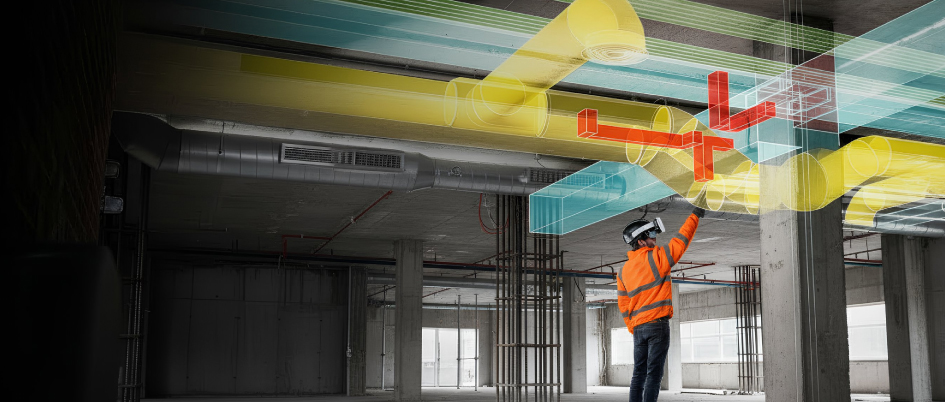
Scenario: A superintendent straps on an AR headset to do a walkthrough the actual construction site, with the BIM model overlaid on top of the physical structure. He immediately sees a future conflict between ceiling-mounted lights and sprinkler heads—visible in the headset but not yet physically installed. The design is adjusted on the spot before anyone breaks out the drywall saw.
4. Skills of the Future
BIM professionals must now learn:
- Data analysis and AI fundamentals
- Working with APIs and cloud tools
- Cross-disciplinary coordination strategies
Conclusion
Integrating AI into BIM workflows requires us to zoom out and look at the bigger picture of what’s really happening. There are several ways to bring AI into the mix — for instance, instead of expecting the AI (like ChatGPT) to perform the actual design calculations or modeling tasks, you can use ChatGPT’s API to generate inputs or instructions and connect those to external tools or code that do the heavy lifting. The AI simply figures out when and how to trigger those tools using a feature called “function calling.”
By reducing design conflicts, accelerating coordination, and improving collaboration, AI-powered BIM clash detection is transforming how we build. The question is no longer “if you’ll adopt it”—it’s “how soon before your competitors already did.”
Whether you’re designing high-rises, hospitals, or infrastructure projects, Enginero’s AI-powered BIM coordination platform helps you detect, manage, and resolve clashes faster and smarter.
Don’t lag behind! Partner with Enginero as we offer AI-integrated BIM clash detection services and see the difference firsthand.
- Automate clash grouping
- Collaborate in real time across teams
- Eliminate design errors before they hit the site
Start building smarter today. Explore Enginero’s BIM clash detection services now!
Frequently Asked Questions (FAQs)
What is BIM clash detection, and why does it matter?
BIM clash detection is the process of spotting conflicts and errors if any in the model (like overlapping pipes or walls) in a 3D building model even before construction starts. Spotting these early in the process saves loads of time, money, and headaches on-site.
How does AI improve clash detection in BIM?
AI automates the process, learns from past mistakes, filters out false alarms, and even predicts future clashes.
What are the main benefits of using AI-powered clash detection?
Expect early error detection, real-time collaboration (even across continents!), clearer reporting, less manual review, and last not the least fewer project delays.
What should I look for in BIM clash detection software?
Key features: strong AI integration, cloud access for real-time teamwork (anytime-anywhere connectivity), great compatibility with different software/formats, and scalability for large projects.
What’s coming next for BIM and AI?
The future includes as-needed use of AI integration through API, clash-free designs generated automatically, real-time model updates via digital twins, on-site visualization with AR/VR, and BIM experts learning new tech skills to stay ahead.
Leave a Reply