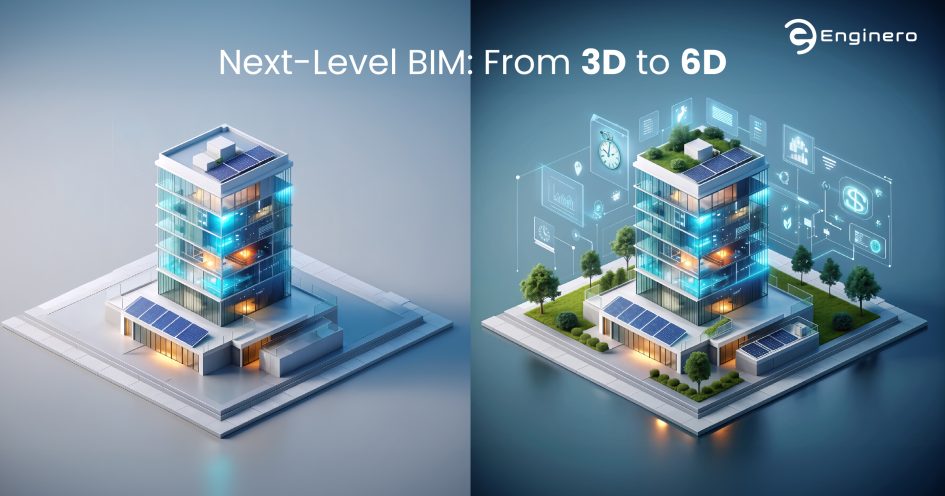
The construction industry is advancing day by day, starting from computer-aided designing/drafting to digital twins and IoT. Advanced technologies help project heads find innovative ways to elevate construction engineering to the next level.
Adapting new technologies is not an easy task; it needs to be quickly adaptive and easy to implement by various teams. Construction designs and project management have mostly been through various phases, and the most common element here is coordination. Having coordination between project teams and their respective outputs (designs) is mandatory to achieve a precise construction project in today’s scenario.
In the era of digital construction, Building Information Modeling (BIM) has been proving its excellence when it comes to delivering utmost collaboration and accurate outcomes. Once, BIM technology was limited to 3D visualizations, but now BIM has evolved into a multidimensional powerhouse, extending its reach to time, cost, and sustainability, along with 3D.
Moving forward from 3D to 6D BIM has taken various steps, and this movement in your projects is possible with a strategic execution with your project stakeholders, heads by leveraging coordination and lifecycle management.
In this article, we are going to dive into how each BIM dimension contributes to the coordination process. We will also look at how the shift from 3D to 6D is transforming the way we design, construct, and manage our infrastructure.
Understanding BIM Dimensions and 3D BIM Modeling
Before delving into the BIM advancements, let us have a look at the dimensions of BIM. Dimensions in BIM refer to the different aspects of the BIM process. Each dimension of BIM has its perspective, incorporating the features of the preceding one. For instance, 3D BIM inherits the features of 2D BIM as well, along with its unique capabilities.
Now, starting with the 2D BIM,
2D BIM Dimension is the basic and traditional dimension, utilized widely in various design industries. It includes two dimensions, the x-coordinate and the y-coordinate, also known as the x and the y axes, which are easily represented in a graph or a paper manually, without the aid of a digital tool. Also, 2D BIM drawings are made by digital tools like AutoCAD, SketchUp, and more.
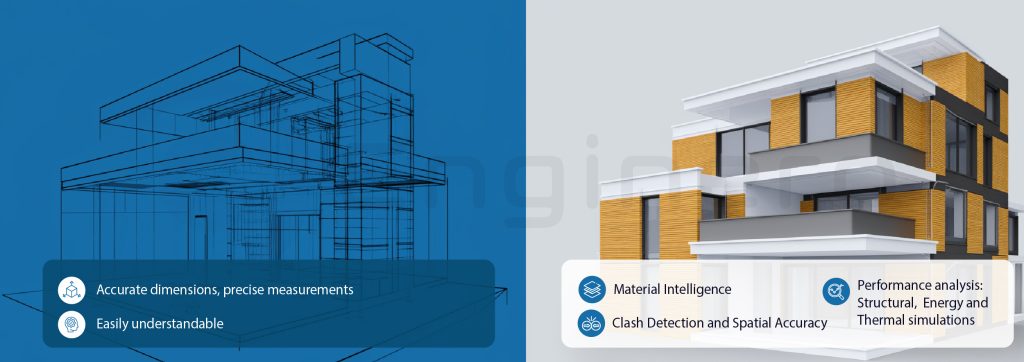
What is 3D BIM Modeling? How does it impact Construction Projects?
Just like 2D BIM dimensions, 3D BIM also includes x and y coordinates along with an additional z coordinate. 3D BIM defines the primary usage of BIM modeling by visualizing the project blueprint in a three-dimensional way, which means how it should be. This gives the project stakeholders a clear picture of the whole building project, including various aspects like plumbing systems, electrical wiring, interior designs, structural elements like beams and columns, and much more in one 3D picture.
When we look at the technical aspects, 3D BIM includes all the material properties, dimensions, functionality, geometrical elements, spatial features, and many more comprehensively and simply.
One of the key features of 3D BIM is that it aids in detecting issues and irregularities between different models when each project model is combined as a federated model. These irregularities are termed as clashes. Clashes are crucial, and early detection of clashes helps a lot in maintaining accuracy and precise project delivery.
Key Benefits
- Early Clash Detection
- Complete project visualization in 3D
- Store Material and Performance parameters
- Better coordination among teams
- Effective project and facility management
- Work-sharing with cloud-based collaboration
In Short, 3D BIM modeling is essential in the Architecture, Engineering, and Construction (AEC) industry. They specialize in crafting smart, data-rich 3D models of buildings and infrastructure. These experts offer a range of services, including architectural, structural, and MEP (Mechanical, Electrical, Plumbing) modeling, which greatly enhances design visualization, coordination, and clash detection.
Moving Beyond 3D: The Rise of 4D, 5D, and 6D BIM
BIM technology is not just limited to 3D visualization and clash detection; it has empowered its capabilities by advancing its dimensions. BIM started out with a focus on 3D models that highlighted geometry and spatial relationships, but it has quickly transformed into a versatile tool that goes well beyond just visualization. Welcome to the world of 4D, 5D, and 6D BIM – each new dimension brings added intelligence and value to the entire construction lifecycle.
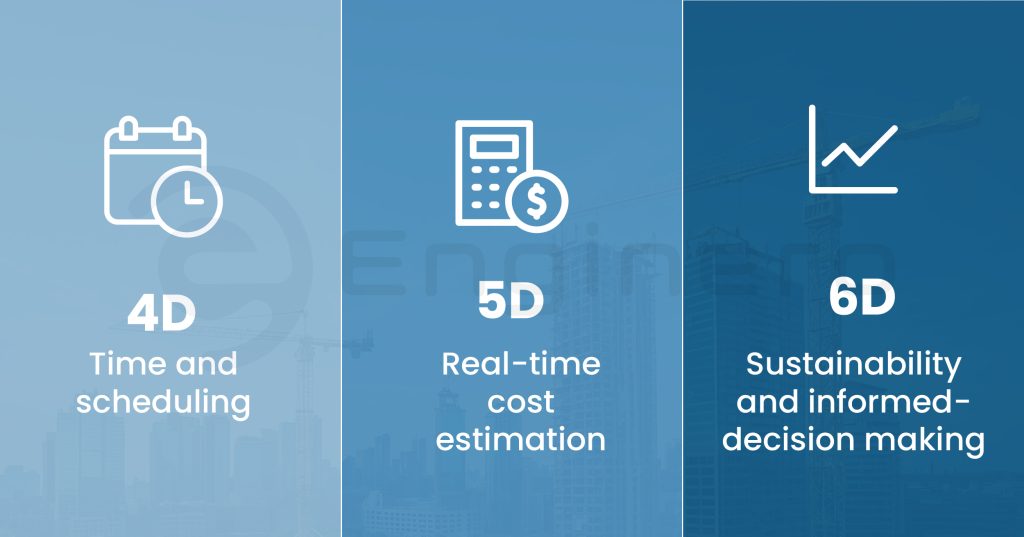
4D BIM Dimension – Time and scheduling
A four-dimensional BIM adds extra potential to the 3D BIM. In the 4D BIM dimension, BIM comes with time and scheduling features, also known as the time element or time dimension. This dimension adds value to the 3D BIM model by allowing the project heads/managers to add schedules of operation.
This dimension helps in deciding the time duration, execution, and activities as per the project schedule. It helps stakeholders outline the process by adding various tasks, methodologies, and durations to complete those.
How does 4D BIM Dimension benefit?
- Aids you in making accurate plans and schedules
- Improves coordination by maintaining tasks and deadlines clearly
- Reduces project management and schedule-related conflicts
- Mitigates delays
- Better project alignment with timelines
5D BIM Dimension – Cost and Budget
5D BIM adds another dimension to the 4D BIM, which is cost estimation and budgeting. With 5D BIM, project heads decide the estimated building project cost. It helps you analyze various financial risks, overruns, and all related queries regarding the project budget.
Various project budgets include labor charges, materials, equipment costs, software and hardware tools charges, individual team budgets, and much more.
Not only about the budget allocation, but also the feasibility analysis is made simple with 5D BIM. Project heads can forecast the risks and shortcomings and ensure the project is safe financially.
An estimate of every element, component, and structure designed is calculated. It aids different teams in coordinating and solving financial issues. With clear budget allocation, teams can work on the project tasks.
How does 5D BIM Dimension benefit?
- Project visualization with cost and time estimation
- Help with changing costs and budgets whenever needed
- Saves time in separate scheduling and budgeting
- Optimum resource allocation
- Improved coordination and fewer cost overruns
6D BIM Dimension – Sustainability and Facility Management
6D BIM dimension advances the capability, not just three-dimensional visualization, cost, or scheduling; it goes beyond advanced features, focusing on maintenance, sustainability, and building operations.
Unlike 3D, 4D, and 5D BIM, 6D BIM goes beyond and embeds the data necessary for facility management and operations. This helps project heads and facility managers who are responsible for the day-to-day operation and long-term upkeep of buildings.
Essentially, the 6D BIM model contains comprehensive details about various building components, including the materials used, installation dates, warranty periods, and maintenance schedules. With this information at their fingertips, facility managers can plan and execute preventive maintenance more efficiently, which can help minimize downtime and avoid expensive repairs.
How does 6D BIM Dimension benefit?
- Improves coordination and supports decision-making
- Help manage project status, decide maintenance schedules, and operational safety procedures
- Supports sustainability goals by monitoring energy and environmental performance
- Reduced operational costs and resource allocation by improved planning procedures
Key Benefits of Expanding from 3D to 6D BIM
Reduced clashes and rework
Stepping away from the usual 3D modeling, higher-dimensional BIM brings together scheduling and cost data, allowing for a more thorough planning process. This approach helps spot and tackle design conflicts or construction sequencing problems before they even hit the site. As a result, project teams can mitigate expensive rework, cut down on delays, and keep a tighter grip on quality control.
Accurate time and cost forecasting
The fourth dimension, which includes time and scheduling, along with the 3D visualization, helps you in determining the time duration needed to complete project tasks, reducing time overruns and surplus. The other dimension, the fifth dimension of BIM, adds a cost element to allocate and forecast the budget of the whole project, including labor costs, machinery charges, equipment, and much more.
Sustainable and energy-efficient building operations
The sixth dimension adds a sustainability and operational management function to the BIM model. This helps you in incorporating data related to energy and ways to store it, usage of green and clean energy, environmental impact, and further maintenance requirements.
Better decision-making across the project lifecycle
Integrating time, cost, and scheduling dimensions makes a comprehensive dataset for product and lifecycle management. This helps stakeholders manage risks, access building data for maintenance and improvements, and make necessary decisions for improving project accuracy. Also, it helps you advance your projects to futuristic technologies like IoT and Digital Twins.
Improved ROI for stakeholders
Enhanced coordination with fewer wastes and better time and cost control, all of which translate into increased tangible returns for stakeholders. 6D BIM also allows for better asset management during post-construction, thus assisting in reducing the operating cost for the building owners and increasing the life span of building components.
Best Practices for a Successful Transition
For transitioning from 3D to 6D, there is no standard process. Implementing and adapting the latest trends with proper supporting systems helps your teams to transition to 6D BIM successfully. Here are a few best practices that help you in upgrading your BIM workflows effectively.
Start with 3D BIM Modelling
For every BIM process, start by preparing a 3D BIM model, providing all the geometric and engineering data that support visualization, clash detection, and better decision-making.
Choose Scalable BIM Coordination Software
Select BIM Coordination tools like Enginero for advancing BIM features like model coordination, creating federated models, clash detection, work-sharing between teams, and team collaboration. This ensures that the BIM processes are streamlined across the whole project, irrespective of location, project size, and project disciplines.
Involve Stakeholders
Engage all your project stakeholders, architects, contractors, engineers, designers, vendors, and project heads/owners from the beginning of the BIM process itself so that everyone is aware of the ongoing processes.
Implement Standards and Protocols
Create a standard BEP (BIM execution plan) and standardize all the naming conventions, procedures, and quality standards. Make sure the whole project team follows the same protocols and ensure everyone is updated with the most recent information.
Continuous training and upskilling
Invest in training and upskilling your project teams when new technologies are implemented. Implement workshops and direct jargons for the employees in adapting and implementing BIM in their daily tasks.
Conclusion
Transitioning from 3D to 6D BIM, more than a technological upgrade, is a strategic evolution that fosters collaboration, thus enhancing accuracy and optimization of every construction life-cycle phase.
The integration of time, cost, and sustainability dimensions into BIM processes facilitates smoother project execution and, at the same time, ensures that assets provide better performance over the long term. When set up with the appropriate tools, team coordination, and best practices, high-dimensional BIM implementation becomes a platform through which project delivery and benefits derived by all stakeholders may be accelerated.
BIM is again not limited to 6D; it goes beyond that. BIM technology helps you integrate your buildings with futuristic innovations like AI/ML integration, digital twinning building projects, AR/VR integration, generative designs, and IoT (Internet of Things).
As technology keeps advancing, it is crucial for companies to embrace advanced BIM processes if they want to remain competitive, enhance collaboration, cut costs, and create smarter, more sustainable built environments.
Leave a Reply